This Review Reveals Minor Details About the Plot.
Plain and Simple

Plot Overview
 Undercover Philly narcotics cop Zenovich (Timothy Carhart)
has been working in Florida in 1984 where he's unknown to the drug
consortium. Unfortunately, crooked Philly police lieutenant
James McFee (Danny Glover) decides to vacation there and recognizes
the bloke (“Make one mistake and they kill you”), so he
hops a train back to his start and holes up in the men's room until
the coast is clear. He's got a nice tan and is dressed in Levis.
His pursuer arrives by car and has the place under
surveillance until his evil backup arrives. They dispatch
him as he's washing his face.
Undercover Philly narcotics cop Zenovich (Timothy Carhart)
has been working in Florida in 1984 where he's unknown to the drug
consortium. Unfortunately, crooked Philly police lieutenant
James McFee (Danny Glover) decides to vacation there and recognizes
the bloke (“Make one mistake and they kill you”), so he
hops a train back to his start and holes up in the men's room until
the coast is clear. He's got a nice tan and is dressed in Levis.
His pursuer arrives by car and has the place under
surveillance until his evil backup arrives. They dispatch
him as he's washing his face.


 Hiding in a stall, witnessing the
event is eight-year-old Amish boy Samuel (Lukas Haas) who is
traveling w/his recently widowed mother Rachel Lapp (Kelly
McGillis.) His description to the police is less helpful than it
might have been as he's never before seen a black person and has to
reference Capt. John Book
(Harrison Ford)'s Negro partner Carter (Brent Jennings) to describe
the race of the killer. He's crossed paths with two short black
dudes that very day so he describes his build by comparison as
“not schtumpig,” that is, “not a
runt.” John rousts a convenient tall black guy, “Sorry,
honest mistake.” They are able to focus in on McFee a media
poster child, but with the dirty chief in on it, John and the Lapps
must flee the city. Rachel prays over their hot dogs along the way,
but as the chief remarks, “Can you see John at a prayer
meeting?” Their religions are mismatched, though John is a
straight shooter otherwise. Samuel's grandfather discusses
pacifism with him:
Hiding in a stall, witnessing the
event is eight-year-old Amish boy Samuel (Lukas Haas) who is
traveling w/his recently widowed mother Rachel Lapp (Kelly
McGillis.) His description to the police is less helpful than it
might have been as he's never before seen a black person and has to
reference Capt. John Book
(Harrison Ford)'s Negro partner Carter (Brent Jennings) to describe
the race of the killer. He's crossed paths with two short black
dudes that very day so he describes his build by comparison as
“not schtumpig,” that is, “not a
runt.” John rousts a convenient tall black guy, “Sorry,
honest mistake.” They are able to focus in on McFee a media
poster child, but with the dirty chief in on it, John and the Lapps
must flee the city. Rachel prays over their hot dogs along the way,
but as the chief remarks, “Can you see John at a prayer
meeting?” Their religions are mismatched, though John is a
straight shooter otherwise. Samuel's grandfather discusses
pacifism with him:
Samuel Lapp: “I would only kill the bad man.”Eli Lapp: “Only the bad man. I see. And you know these bad men by sight? You are able to look into their hearts and see this badness?”
Samuel Lapp: “I can see what they do. I have seen it.”
This wry humor reflects a certain Civil Rights sentiment of judging a person by his character, not by his skin color. No big deal is made of it, but there's a persistent visual backdrop suggesting a longer history along the lines of author Charlton Ogburn:
The people of the South are like a people who have a home together, or the memory of such a home. Perhaps the presence of Negroes has contributed to this. They came as primitives and they composed a peasantry, providing the society with roots in the soil. They were much a part of the Southern soul, as the Russian peasants were so much a part of the Russian soul—as I think a peasantry may be indispensable to the soul of a people. And perhaps that is what we are talking about—whether a people has a soul. Also, there was the long and terrible war. It took away from the people everything. It was the reverse of material progress and industrialization. The people were brought close to the soil and close to one another because nothing else was left. (363)

 John succeeds in blending in with
the Amish off the grid until a confrontation with some tourists
takes place. Some rowdy teenagers white-face paint a hapless Amish
man with a gibbous vanilla cone—he looks cute—while
these pacifists take it in stride. John intervenes as a cop used to
rousting low lifes as a matter of course, and well, “Make one
mistake and they kill you.” The baddies descend on the
exposed farm with a police-action hand-grip shotgun, a service
revolver, and a long shotgun. John doesn't have access to his
weapon. He's not above a food fight, though, and the farm is replete with
foodstuffs. Maybe he can pull a MacGyver. Daniel is also a wild card
whether he will cut & run or stay and contribute.
John succeeds in blending in with
the Amish off the grid until a confrontation with some tourists
takes place. Some rowdy teenagers white-face paint a hapless Amish
man with a gibbous vanilla cone—he looks cute—while
these pacifists take it in stride. John intervenes as a cop used to
rousting low lifes as a matter of course, and well, “Make one
mistake and they kill you.” The baddies descend on the
exposed farm with a police-action hand-grip shotgun, a service
revolver, and a long shotgun. John doesn't have access to his
weapon. He's not above a food fight, though, and the farm is replete with
foodstuffs. Maybe he can pull a MacGyver. Daniel is also a wild card
whether he will cut & run or stay and contribute.
Ideology


 As John is recuperating in situ from
his gunshot wound, Eli puts him to work milking the cows
(“Moo.”) Then being a carpenter he raises the
birdhouse he'd damaged in his flight (“We can always use
a good carpenter.”) And he joins the men in Zook's barn-raising, a
one-day community affair to present it to the newly married couple. The
women cook the food and knit a quilt while the men and boys pound nails.
As John is recuperating in situ from
his gunshot wound, Eli puts him to work milking the cows
(“Moo.”) Then being a carpenter he raises the
birdhouse he'd damaged in his flight (“We can always use
a good carpenter.”) And he joins the men in Zook's barn-raising, a
one-day community affair to present it to the newly married couple. The
women cook the food and knit a quilt while the men and boys pound nails.


 If a full blown marriage
would rate a full size barn, then the small potatoes relations
developing between John and Rachel might call for a birdhouse.
If a full blown marriage
would rate a full size barn, then the small potatoes relations
developing between John and Rachel might call for a birdhouse.

 They discuss it:
Rachel Lapp: “Your sister says you don't have a family.”John Book: “No, I don't.”
Rachel Lapp: “She thinks that you ought to get married and have children of your own, instead of trying to be a father to hers.”
John Book: “Yeah.”
Rachel Lapp: “Except she thinks you are afraid of the responsibility.”
 In a parallel situation of mixed-sex
cohabitation Paul advised the widow, (1Cor. 7:39) “she is at liberty
to be married to whom she will; only in the Lord.” The Jews
had a custom called levirate marriage. If a woman's husband being
an eldest brother died and they were childless, she was
obligated to marry his younger brother, or in pinch some other near
kinsman, to continue the former's line. The Jews in Corinth had
asked the apostle Paul if any of that carried over to Christianity,
and he replied no, that the widow had as open season on men as did
a single girl. “Only in the Lord” means she had to
court with holiness in body and spirit. That might be hard to do if
she were on loving terms with her ex's brother(s) in which case it
is but a small step to sexual intimacy. Although levirate marriage
is not so common today, we get an intimation of this issue in this
story from an Amish colony. “If we'd made love last
night,” said John, “I'd have to stay. Or you'd have to
leave.” Said Rachel, “I've committed no sin.”
Their personal business was properly in the Lord.
In a parallel situation of mixed-sex
cohabitation Paul advised the widow, (1Cor. 7:39) “she is at liberty
to be married to whom she will; only in the Lord.” The Jews
had a custom called levirate marriage. If a woman's husband being
an eldest brother died and they were childless, she was
obligated to marry his younger brother, or in pinch some other near
kinsman, to continue the former's line. The Jews in Corinth had
asked the apostle Paul if any of that carried over to Christianity,
and he replied no, that the widow had as open season on men as did
a single girl. “Only in the Lord” means she had to
court with holiness in body and spirit. That might be hard to do if
she were on loving terms with her ex's brother(s) in which case it
is but a small step to sexual intimacy. Although levirate marriage
is not so common today, we get an intimation of this issue in this
story from an Amish colony. “If we'd made love last
night,” said John, “I'd have to stay. Or you'd have to
leave.” Said Rachel, “I've committed no sin.”
Their personal business was properly in the Lord.

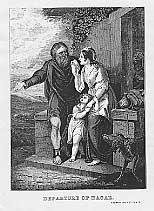 Eli expressed a keen objection to Rachel's possible course of
violating the Ordnung should she marry an
“Englishman,” quoting (2Cor. 6:17) “Wherefore come
out from among them, and be ye separate, saith the Lord, and touch
not the unclean thing.” But from the plural case “be
ye separate,” that has to do with the composition of
their church, not individual marriages per se. The couples have to
decide for themselves whom to marry. Many churches' Ordnungs prohibit
mixed marriage, they having not read or heeded the plural context
of the verse in the Greek or the KJV and/or dumbing down modern translations.
Eli expressed a keen objection to Rachel's possible course of
violating the Ordnung should she marry an
“Englishman,” quoting (2Cor. 6:17) “Wherefore come
out from among them, and be ye separate, saith the Lord, and touch
not the unclean thing.” But from the plural case “be
ye separate,” that has to do with the composition of
their church, not individual marriages per se. The couples have to
decide for themselves whom to marry. Many churches' Ordnungs prohibit
mixed marriage, they having not read or heeded the plural context
of the verse in the Greek or the KJV and/or dumbing down modern translations.
Production Values
“” was directed by Peter Weir. It was written by William Kelley, Pamela Wallace and Earl W. Wallace. It stars Harrison Ford, Kelly McGillis and Lukas Haas. Ford was in fine form and the Amish and professionals all did well.

 It was certified R The dramatic movie kiss expressed the
couple's relief at making it to first base. The plot well developed
a confluence of culture clash, policing and romance while dropping
in droll humor from time to time. It's the kind of movie that will
stick in your memory. Of course, my being from Pennsylvania
might have something to do with it, too.
It was certified R The dramatic movie kiss expressed the
couple's relief at making it to first base. The plot well developed
a confluence of culture clash, policing and romance while dropping
in droll humor from time to time. It's the kind of movie that will
stick in your memory. Of course, my being from Pennsylvania
might have something to do with it, too.
Review Conclusion w/a Christian's Recommendation
This movie is timeless combining generational growth with cultural concepts and inconvenient love, all with a dash of aplomb and sincere religious expression. It's the stuff great movies are made of. See it for sure.
Movie Ratings
Action factor: Well done action flick. Suitability For Children: Not Suitable for Children of Any Age. Special effects: Average special effects. Video Occasion: Fit For a Friday Evening. Suspense: Keeps you on the edge of your seat. Overall movie rating: Four and a half stars out of five.
Works Cited
Scripture is quoted from the King James Version. Pub. 1611, rev. 1769. Software.
Lions den picture is copyright © Sweet Publishing. Licensed by
FreeBibleimages.
 This work is licensed under a Creative
Commons Attribution-ShareAlike 3.0 Unported License.
This work is licensed under a Creative
Commons Attribution-ShareAlike 3.0 Unported License.
Ogburn Jr., Charlton. The Gold Of the River Sea. New York: William Morrow and Company, 1965. Print.


 bibles.n7nz.org